Blog

  • Kickoff meeting

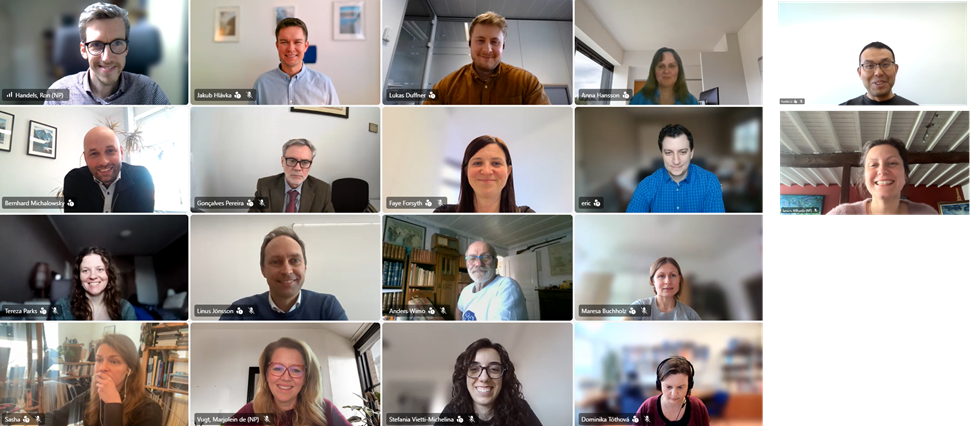
    We kicked off the DEMCAPS project together with our project members and external collaborators. During this virtual meeting we had the opportunity to connect with the team and align on our shared goals. We are enthusiastic to start!

    A key highlight was the presentation by Dr. Eric Jutkowitz, who shared insights into the development of a health-economic model for dementia care in the U.S. He discussed the complexities of implementing non-pharmacological interventions for persons with dementia, drawing on large U.S. datasets from memory clinics and the Health and Retirement Study. His findings underscored the cost-saving potential of many non-pharmacological approaches.

    For further reference, the group picture, slides from Dr. Jutkowitz’s presentation, and background papers are available below.
    Contribution Dr. Eric Jutkowitz

    Bio: https://directory.sph.umn.edu/bio/sph-a-z/eric-jutkowitz

    Jutkowitz E, Pizzi LT, Shewmaker P, Alarid-Escudero F, Epstein-Lubow G, Prioli KM, Gaugler JE, Gitlin LN. Cost effectiveness of non-drug interventions that reduce nursing home admissions for people living with dementia. Alzheimers Dement. 2023 Sep;19(9):3867-3893. https://doi.org/10.1002/alz.12964

    Jutkowitz E, Pizzi LT, Shewmaker P, Alarid-Escudero F, Epstein-Lubow G, Gaugler JE, Gitlin LN. The cost of non-drug interventions that improve function and reduce dementia-related behaviors. BMC Geriatr. 2025 Dec 4;26(1):23. https://doi.org/10.1186/s12877-025-06532-1

  • New JPND project on access to psychosocial support in dementia

    We are excited to present our research project to improve psychosocial support for dementia has been approved by JPND.

    The project is titled: “DEMentia CAre and Psychosocial Support interventions estimating health-economic impact to support access and implementation in practice” (DEM-CAPS)

    Psychosocial support for people living with dementia and their family or friends who care for them are not available to everyone who needs them. One major reason is that there is insufficient information about the long-term benefits and long-term cost savings of providing this type of care. Decision-makers, like governments or health insurers, need solid evidence about whether investing in psychosocial support will save money in the long run by improving people’s lives or helping them stay at home longer before needing nursing care.

    Our project aims to fill this gap by creating a framework to calculate the long-term value of psychosocial support for people with dementia and their caregivers. We will work closely with people living with dementia, caregivers, healthcare professionals, and decision-makers throughout Europe.

    We are thankful for JPND and and the local country funders for the resources to make this project possible and the collaboration between Karolinska Institutet (Sweden), Maastricht University (Netherlands), German Centre for Neurodegenerative Diseases (Germany), Masaryk University (Czech Republic) and Alzheimer Europe (Luxembourg). We look forward to connect with upcoming collaborators in the next years.

    DEM-CAPS team